
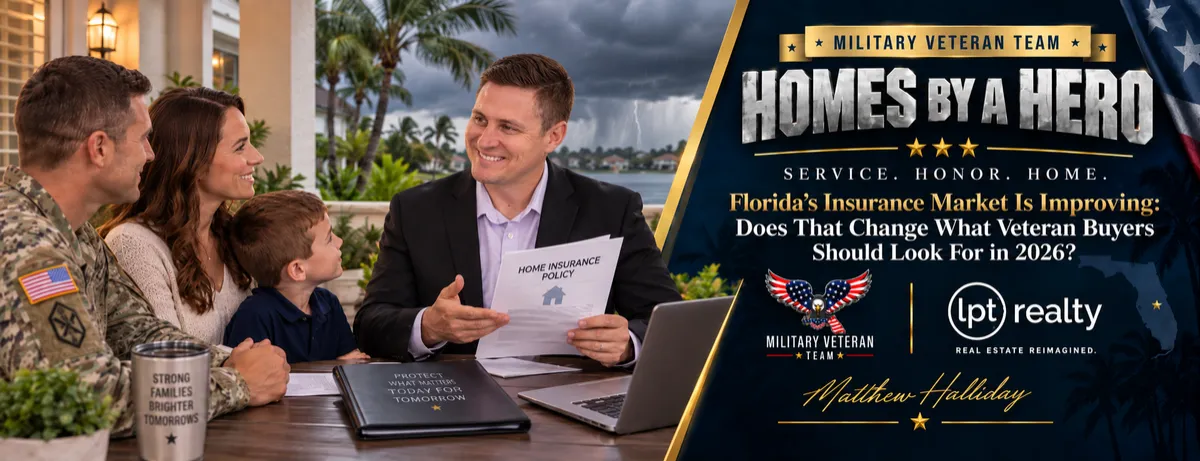
Florida’s Insurance Market Is Improving: Does That Change What Veteran Buyers Should Look For in 2026?
For the last few years, buying a home in Florida has often meant asking an unusual question very early in the process:
Can I actually insure this house at a price I can afford?
That question has not disappeared.
But the answer may be getting a little easier.
Florida's property-insurance market is showing signs of improvement in 2026. Nearly 20 insurers have entered or reentered the state following the insurance reforms enacted in 2022 and 2023, while Citizens Property Insurance—the state's insurer of last resort—has been shrinking as more policies move back into the private market. Industry observers now describe Florida insurers as being in their strongest financial position in more than a decade.
For veterans and military families buying in Tampa Bay, that is encouraging.
But it does not mean insurance can go back to being an afterthought.
More Insurance Options Can Give Buyers More Flexibility
One of the biggest problems Florida buyers faced during the insurance crisis was simply finding enough carriers willing to quote a property.
When there are only one or two realistic options, the buyer has very little leverage.
More private carriers can mean:
More quotes.
More underwriting options.
More competition.
And potentially a better chance of finding coverage that works for the property and budget.
That is especially important for VA buyers working against PCS deadlines.
A family arriving at MacDill may not have months to work through an insurance problem.
Having more carrier options can make a transaction easier to complete.
Improving Does Not Mean Cheap
This is the distinction buyers need to understand.
Insurance availability and insurance affordability are not the same thing.
A carrier may be willing to insure the home.
That does not mean the premium will fit comfortably into your budget.
Roof age, wind mitigation, flood exposure, previous claims, electrical systems, plumbing, and the construction of the home can still influence cost.
That is why I would continue treating insurance almost like another property characteristic.
Buyers compare kitchens.
They compare school districts.
They compare commute times.
In Florida, they should also compare insurability.
The Roof Still Matters
A beautiful home with an aging roof can create a very different ownership picture than a similar home with newer roofing and documented wind-mitigation features.
That does not automatically mean the newer-roof property is the better purchase.
It means the cost needs to be considered.
A $10,000 difference in purchase price may look significant.
But if the cheaper property creates substantially higher insurance costs year after year—or requires a major roof replacement soon—the apparent bargain can disappear quickly.
That is why I keep coming back to one principle:
The cheapest Florida house is not necessarily the cheapest Florida house to own.
More Competition Makes Shopping Insurance Even More Important
When fewer companies were writing policies, buyers often took whatever realistic option was available.
If the market continues improving, buyers should take advantage of the competition.
Do not obtain one quote and assume that is the number.
Ask an experienced Florida insurance professional whether several carriers may be appropriate for the property.
Compare coverage as well as premium.
A cheaper policy with dramatically different deductibles or coverage limitations is not automatically a better policy.
The goal is to understand the true annual cost and protection.
Citizens Should Not Automatically Be Plan A
Citizens exists as an important safety net for Florida property owners who cannot obtain appropriate coverage in the private market.
But the fact that Citizens' policy count has been shrinking is significant.
It suggests more homeowners are finding private-market alternatives.
For a buyer, that means it may be worth exploring the private market thoroughly before assuming Citizens is the only path.
Your insurance professional can explain what is actually available for the specific property.
Military Buyers Still Need to Move Early
Even if Florida insurance is improving, military buyers should not wait until three days before closing to investigate it.
Start while you still have contractual flexibility.
Ideally, during the inspection period you should have a good idea of:
The roof condition.
Wind mitigation.
Any 4-point issues.
Flood exposure.
Available carriers.
Estimated annual premium.
Required deductibles.
Then compare that information with the rest of the housing payment.
Do Not Let Better Headlines Create Complacency
This is probably the biggest risk of an improving market.
People hear:
“Florida insurance is getting better.”
And translate it into:
“I don't need to worry about insurance anymore.”
That would be a mistake.
Florida remains a hurricane-exposed state.
Insurance remains a major ownership expense.
And two homes in the same price range can still produce dramatically different insurance costs.
The improvement should give buyers more confidence.
It should not eliminate due diligence.
The Bottom Line
Florida's improving insurance market is good news for veteran and military homebuyers.
More carriers and a shrinking Citizens footprint can mean more options and potentially fewer transactions derailed because coverage cannot be secured.
But the strategy remains the same:
Investigate insurance early.
Compare multiple properties.
Look beyond purchase price.
Understand the roof.
Understand storm protection.
And know what the home will actually cost to own before you commit.
For veterans and military families buying in Tampa Bay, that preparation can make the difference between finding a house that merely qualifies and finding one that remains financially comfortable after closing.
Matthew Halliday
Navy Veteran | Realtor
Military Veteran Team | LPT Realty
Homes by a Hero