
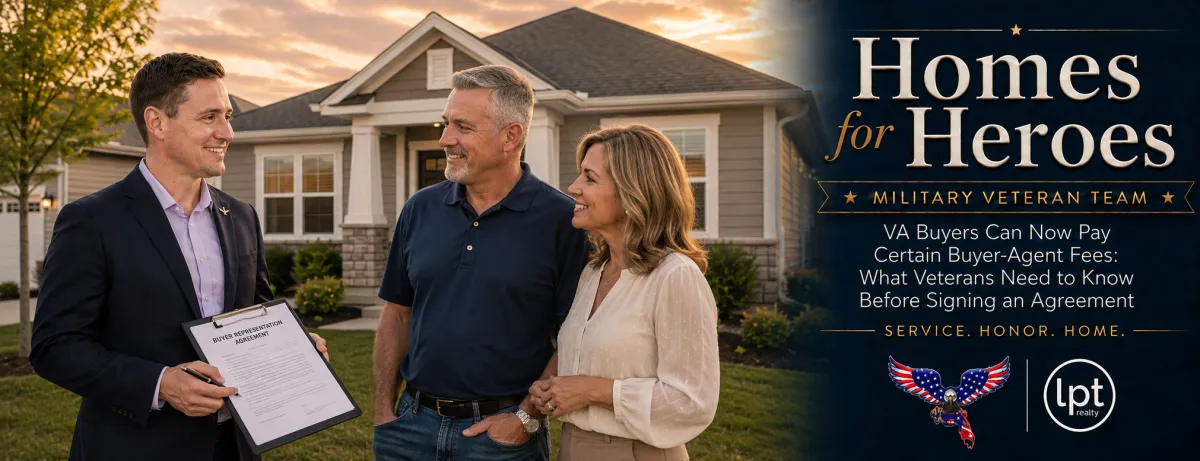
VA Buyers Can Now Pay Certain Buyer-Agent Fees: What Veterans Need to Know Before Signing an Agreement
Buying a home with a VA-backed loan has always come with protections designed to keep veterans from being burdened with unnecessary fees.
But the real-estate compensation landscape has changed, and VA buyers need to understand one important update before they begin touring homes:
Veterans using VA financing may, under VA’s current temporary variance, pay certain reasonable and customary buyer-broker charges.
The change was created so VA buyers would not be placed at a competitive disadvantage in a market where buyer-agent compensation is increasingly negotiated directly between buyers and their agents. The VA’s current home-buying guidance also specifically tells veterans to read their agent agreements carefully and understand fees, commissions, rights, and obligations before signing.
For veterans, the lesson is simple:
Know who represents you, what they are being paid, and who is responsible for that payment before you start shopping.
What Is a Buyer Representation Agreement?
A buyer representation agreement is a contract between a homebuyer and a real-estate professional or brokerage.
It typically explains things such as:
What services the agent will provide
How long the agreement lasts
Whether the relationship is exclusive
How compensation is calculated
What happens if the seller does not cover the buyer-agent compensation
How the agreement can be terminated
This is not something a veteran should sign simply because someone says, “It’s standard.”
Read it.
Ask questions.
Understand the dollar amount or percentage involved.
Your Realtor should be able to explain the agreement clearly before asking you to sign it.
Why Did VA Make This Change?
Historically, VA rules generally prevented veteran borrowers from paying real-estate brokerage commissions directly.
That worked more easily in an environment where seller-side compensation commonly covered the buyer’s agent.
As industry practices changed, VA recognized that a complete prohibition could potentially put veterans at a disadvantage.
VA therefore created a temporary local variance allowing veterans to pay certain buyer-broker charges when appropriate. The variance remains listed as valid until rescinded.
The purpose was not to create another expense for veterans.
It was to preserve their ability to compete for homes and choose professional representation.
Does This Mean the Veteran Always Has to Pay?
No.
This is one of the most important points.
Just because VA permits certain buyer-agent charges does not mean every VA borrower will automatically pay them.
Real-estate compensation can be part of the negotiation.
VA’s current closing-cost guidance states that buyers and sellers can negotiate who pays commissions and fees for real-estate professionals.
Depending on the transaction, compensation might be handled by:
The seller
The listing brokerage
The buyer
A negotiated combination
Another permissible structure
The exact arrangement needs to be understood before the buyer becomes contractually committed.
Understand the Agreement Before You Tour Homes
This is where I would encourage veterans to slow down.
It is easy to become focused on the fun part:
Finding the house.
But the professional relationship should be clear first.
Before touring properties with an agent, ask:
How are you compensated?
Am I responsible for any portion of your fee?
What happens if the seller offers less compensation than our agreement specifies?
Can compensation be negotiated as part of the purchase offer?
How long am I committed to this agreement?
What happens if I decide to work with someone else?
Those are normal questions.
A professional should be comfortable answering them.
Do Not Confuse Agent Compensation With Other VA Closing Costs
Buyer-agent compensation is only one piece of the transaction.
VA borrowers may also encounter expenses involving appraisal, taxes, title-related charges, insurance, loan costs, and other items.
VA notes that many closing costs can be negotiated between buyer and seller and that seller credits may cover some or all eligible buyer closing costs, subject to applicable VA rules.
That is why the whole transaction needs to be considered together.
Saving money in one area may matter more than negotiating another.
Representation Still Matters
There is another side to the conversation.
Avoiding a professional fee is not automatically a victory if it means entering one of the largest financial transactions of your life without appropriate representation.
Military buyers can have unusual circumstances:
PCS deadlines.
VA financing requirements.
Remote purchases.
Deployment schedules.
Powers of attorney.
Compressed timelines.
A good buyer's agent should help coordinate all of those moving parts while protecting the buyer's interests throughout the transaction.
The goal should not simply be finding the cheapest representation.
It should be understanding the value, the cost, and the relationship before committing.
Do Not Assume VA Buyers Are at a Disadvantage
VA financing is an earned benefit.
Veterans should not enter negotiations believing they must accept unfavorable terms simply because they are using a VA loan.
The policy change exists in part to give VA borrowers additional flexibility in the modern brokerage environment.
Use that flexibility intelligently.
Understand the agreement.
Know what is negotiable.
And make sure everyone involved understands the VA transaction before the offer is written.
The Bottom Line
VA buyers have more flexibility around buyer-agent compensation than they once did.
That flexibility also creates responsibility.
Before signing a representation agreement, understand:
Who represents you
What services are included
How compensation works
Whether you could owe a fee
What can be negotiated
How the agreement can be ended
The time to understand those terms is before you find the house you love—not when closing is already approaching.
If you are preparing to use your VA benefit to buy in Tampa Bay, I would be glad to walk you through the real-estate side of the process so you understand the representation and transaction before making a commitment.
Matthew Halliday
Navy Veteran | Realtor
Military Veteran Team | LPT Realty
Homes by a Hero